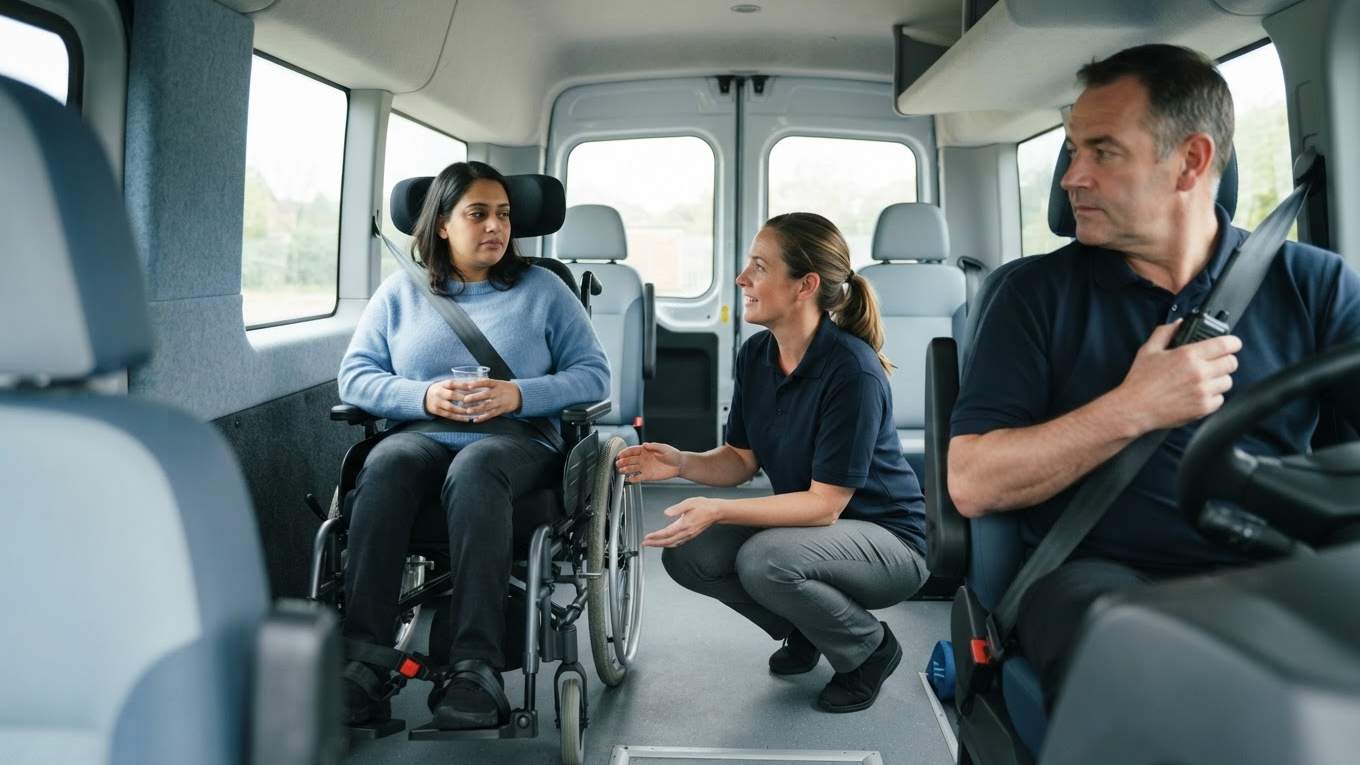
The passenger assistant is the person doing the safeguarding, the communicating and the calming in the back of the vehicle. You meet the child at their front door, you see how they are before anyone at school does, and you are the one who hands them over — settled, or not. That is skilled work, and most of it is not covered by a generic customer-care or induction course.
Our Professional Certificate in SEND Passenger Transport (£69.99) was written for exactly that job. It is the same programme drivers and coordinators take, and it covers what a passenger assistant needs from the first pick-up to the last handover.
What you will learn
- Your role and its boundaries — professional conduct, confidentiality and what families are entitled to expect.
- Understanding SEND — the four broad areas of need, and what autism, learning disability, sensory difference and hidden disabilities look like on a vehicle.
- Communication — working with non-verbal and pre-verbal children, visual and total-communication approaches, and handover with parents and school staff.
- Positive behaviour support — triggers, early signs of distress, low-arousal responses and de-escalation in a confined, moving space.
- Safeguarding — recognising abuse and neglect, the extra vulnerability of children with SEND, handling a disclosure, recording it and escalating it correctly.
- Safe operational practice — boarding and alighting, wheelchair securement and occupant restraint checks, seating decisions and passenger lists.
- Medical awareness — epilepsy, asthma, diabetes and allergy, and acting within the limits of your role.
- Emergencies — breakdowns, collisions, evacuating passengers who cannot self-evacuate, and a missing child.
Each module unlocks when the one before it is complete, and a scenario-based final assessment closes the programme. See all ten modules.
Epilepsy awareness for passenger assistants
Passenger assistants are usually the first to notice a seizure, and some local authorities now require epilepsy training for staff on their school transport contracts. Epilepsy Awareness for SEND Passenger Transport (£24.99, about 90 minutes) covers recognising convulsive and non-convulsive seizures, safe first aid in a moving vehicle, passengers in wheelchairs and harnesses, when to call 999, and recording and handing over afterwards. It is awareness training: it does not authorise you to give rescue medication, which needs separate training and authorisation.
Mapped to what local authorities ask for
The DfE statutory guidance Travel to school for children of compulsory school age says that, as a minimum, training for drivers and passenger assistants should cover safeguarding, handling emergencies, equality — recognising, supporting and communicating with children with disabilities — and the specific needs of the children travelling. The programme covers the knowledge side of all four. Our guide to the training requirements shows the module-by-module mapping, and what still needs to be done in person.
Built around split shifts
Passenger assistant work usually means a morning run, a gap, and an afternoon run. Both courses are entirely online and self-paced: study on a phone, tablet or computer, stop whenever you need to, and pick up where you left off.
What it does not replace
We would rather you knew this before you buy than after:
- It is not a DBS check. Your employer or the local authority arranges an enhanced check with the children’s barred list.
- It is not a practical first aid certificate or a hands-on wheelchair securement session.
- It is not PATS. If your contract names a specific scheme, check what the authority accepts.
- It is a provider certificate, CPD Certified by The CPD Certification Service — not a regulated qualification.
Employing passenger assistants?
Operators and authorities can invite their staff to join their organisation on the platform, assign courses with due dates, track completion live and download certificates when a contract manager or auditor asks. Each member of staff buys and holds their own course or membership in their own name. See how it works for employers.